
Who Is Giorgia Meloni? The Political Journey of Italy’s First Female PM
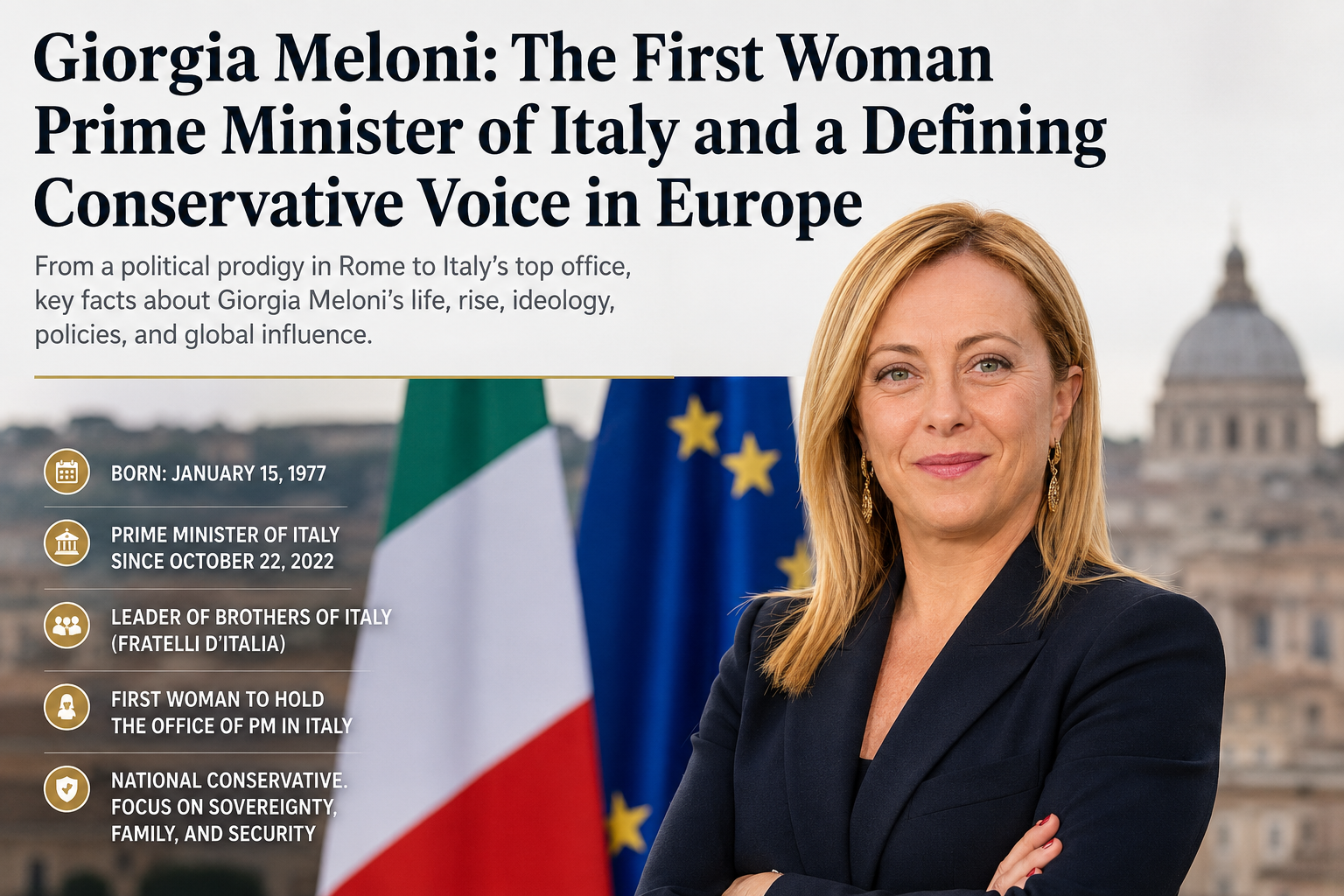
Who Is Giorgia Meloni?
Giorgia Meloni is an Italian politician who has served as Prime Minister of Italy since October 22, 2022. She is the first woman in Italian history to hold the office. She leads the right-wing political party Brothers of Italy (Fratelli d’Italia) and is one of Europe’s most influential conservative leaders.
Quick Facts
| Attribute | Details |
|---|---|
| Full Name | Giorgia Meloni |
| Born | January 15, 1977 |
| Birthplace | Rome, Italy |
| Age | 49 (as of 2026) |
| Political Party | Brothers of Italy (Fratelli d’Italia) |
| Position | Prime Minister of Italy |
| Assumed Office | October 22, 2022 |
| Ideology | National conservatism, right-wing populism |
| Known For | First female PM of Italy, nationalist politics |
| Languages | Italian, some English |
| Partner | Previously Andrea Giambruno |
| Children | One daughter |
Early Life and Background
Meloni was born and raised in Rome’s working-class Garbatella district. Her father reportedly left the family when she was young, and she was raised primarily by her mother. She entered politics at a very early age and became active in youth nationalist movements during her teenage years.
At age 15, she joined the Italian Social Movement (MSI), a post-fascist political party founded after World War II. This early association remains central to debates around her political identity.
Political Rise
Entry Into National Politics
- Elected to Italy’s Chamber of Deputies in 2006.
- Became one of the youngest vice presidents of the chamber.
- In 2008, at age 31, she became Italy’s youngest postwar cabinet minister when appointed Minister of Youth under Prime Minister Silvio Berlusconi.
Founding Brothers of Italy
In 2012, Meloni co-founded Brothers of Italy (Fratelli d’Italia) with Ignazio La Russa and Guido Crosetto after splitting from Berlusconi’s political alliance.
The party:
- Emphasizes nationalism
- Supports stricter immigration controls
- Promotes traditional family values
- Advocates stronger national sovereignty
- Is Euroskeptic but now more pragmatic toward the EU
Initially a small movement, the party grew rapidly after Meloni positioned herself as the only major opposition leader during Mario Draghi’s technocratic government.
Becoming Prime Minister
In Italy’s 2022 general election:
- Brothers of Italy won about 26% of the vote.
- Meloni led a right-wing coalition including:
- The League (Matteo Salvini)
- Forza Italia (Silvio Berlusconi)
She officially became Prime Minister on October 22, 2022.
Her government was widely described as:
- Italy’s first far-right-led government since World War II
- One of the most stable Italian governments in recent decades
Political Ideology
Meloni is generally categorized as:
- National conservative
- Right-wing populist
- Social conservative
She is known for speeches defending:
- National identity
- Christianity
- Traditional families
- Border control
- Sovereignty against supranational bureaucracy
One of her most famous speeches included the line:
“I am Giorgia, I am a woman, I am a mother, I am Italian, I am Christian.”
The speech later became viral internationally.
Key Domestic Policies
Immigration
Meloni strongly supports:
- Tighter border controls
- Reducing irregular migration
- Faster deportation mechanisms
Her government has introduced stricter migration measures and controversial repatriation policies.
Constitutional Reform
Meloni has pushed for major institutional reforms, including:
- Direct election of the prime minister
- Stronger executive powers
- Judicial restructuring
Her proposed “premierato” reform seeks to make Italian governments more stable by strengthening the office of prime minister.
Economic Policy
Economically, her government mixes:
- Fiscal conservatism
- Industrial support
- Tax reductions
- Energy security initiatives
Despite earlier Euroskeptic rhetoric, Meloni has maintained working relations with EU institutions and continued cooperation on EU recovery funding.
Foreign Policy
European Union
Meloni initially built her image criticizing EU bureaucracy. However, as PM she adopted a more pragmatic approach:
- Maintained ties with Brussels
- Worked closely with EU leaders
- Supported EU economic coordination
Ukraine and NATO
She is a strong supporter of:
- NATO
- Ukraine against Russia
- Transatlantic alliances
Her government continued military and diplomatic support for Ukraine after Russia’s invasion.
India Relations
Meloni has significantly deepened Italy’s relationship with India under Prime Minister Narendra Modi.
In May 2026:
- India and Italy elevated ties to a “Special Strategic Partnership.”
- Cooperation expanded in:
- Defence
- Trade
- Technology
- Manufacturing
- IMEC corridor projects
The “Melodi” Viral Trend
Meloni became widely known in India due to her friendly public interactions with Prime Minister Narendra Modi.
The internet nickname “Melodi” combines:
- Meloni
- Modi
In May 2026:
- Modi gifted her Melody toffee during a Rome visit.
- Their selfie and video exchange went viral globally.
- The clip reportedly crossed 100 million views within hours.
Public Image
Meloni projects herself as:
- Nationalist
- Assertive
- Anti-establishment
- Family-oriented
- Strong on identity politics
Supporters see her as:
- A stabilizing conservative leader
- A defender of Italian interests
Critics accuse her of:
- Normalizing far-right politics
- Using anti-immigrant rhetoric
- Weakening liberal institutions
Personal Life
Meloni has one daughter. She was previously in a relationship with Italian TV journalist Andrea Giambruno. Reports indicate the relationship ended publicly in 2023 after controversy involving televised remarks by Giambruno.
She often references motherhood and family values in speeches.
Why Giorgia Meloni Matters Globally
Meloni is now considered:
- One of Europe’s most powerful conservative leaders
- A major voice in EU politics
- An influential figure in debates around:
- Immigration
- National sovereignty
- Conservative identity politics
- Europe’s future direction
Her rise reflects broader political shifts across Europe toward nationalist and right-conservative movements.