
900 Snakes Escaped Into a Chinese City During Floods — What Happened Next Is Nightmare Fuel
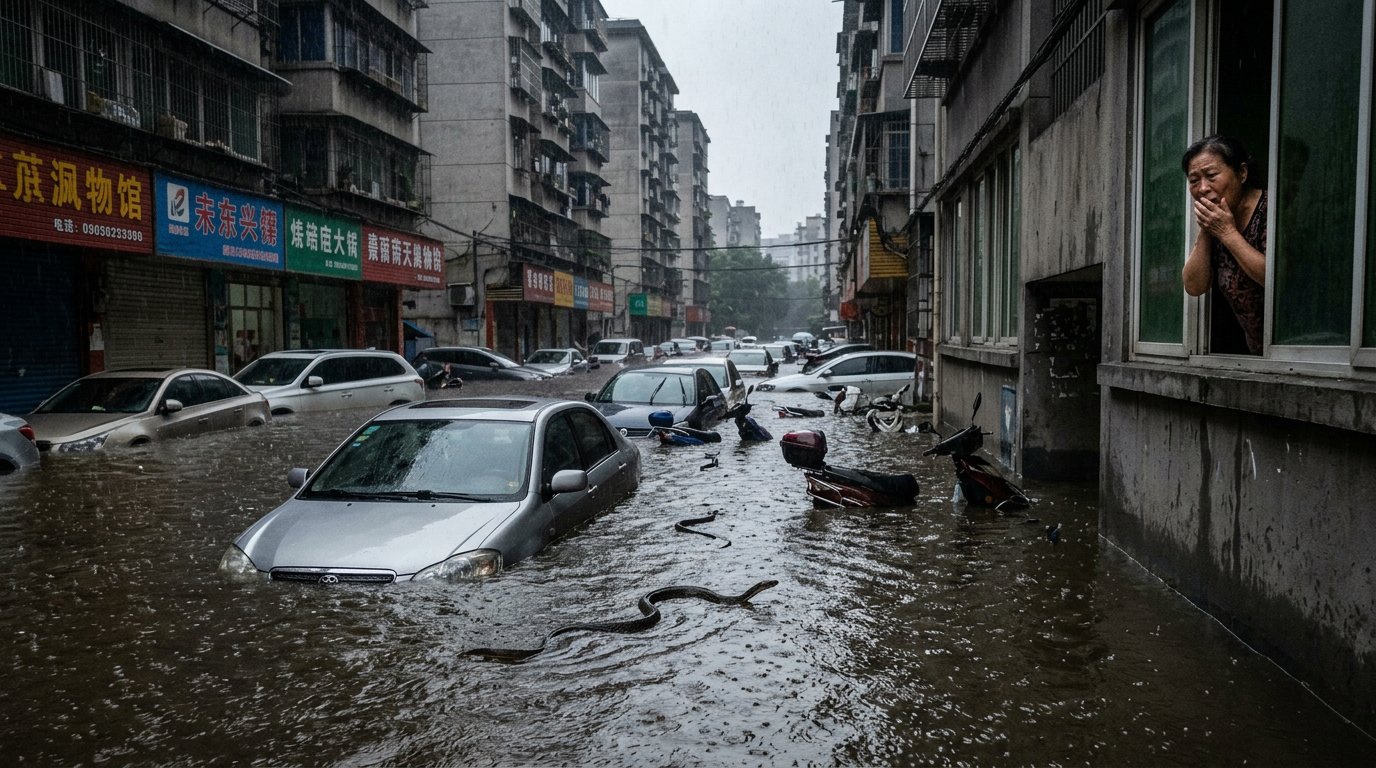
I want you to imagine, for a moment, that you live in a quiet residential neighborhood in central China. It has been raining heavily for three days straight. The local news is warning about rising water levels along the Yangtze River and its tributaries. You have moved your valuables upstairs. You have stocked bottled water and instant noodles. You think you are prepared for whatever comes next.
Then, at approximately 6 AM on a Tuesday morning, you look out your second-floor window and see a snake swimming down what used to be your street.
Then another snake.
Then ten more.
Then you notice that the water itself seems to be moving with dark, sinuous shapes — dozens of them, maybe hundreds — gliding through the floodwater toward higher ground. Toward homes. Toward wherever people are sheltering.
This is not the opening scene of a horror movie. This is not a creative writing exercise. This is exactly what happened in the city of Yueyang, in China’s Hunan province, during the first week of July 2026.
The Floods That Broke the Farm
China’s summer monsoon season is always devastating, but 2026 has been catastrophic on a scale not seen in decades. Record-breaking rainfall across central and southern China has caused the Yangtze River — the third-longest river in the world and the economic artery of central China — and its hundreds of tributaries to swell to levels not recorded since the catastrophic floods of 1998, which killed over 3,000 people and displaced 15 million.
By the first week of July 2026, entire towns in Hunan, Hubei, and Jiangxi provinces were underwater. Over 2 million people had been evacuated. The economic damage, still being assessed, is expected to exceed $40 billion. Crops have been destroyed on a massive scale. Infrastructure that took decades to build has been washed away in hours.
But in Yueyang, a city of roughly 5 million people located where the Xiang River meets the Yangtze, the water did something that nobody anticipated. It did not just destroy buildings and roads and crops. It reached a commercial snake breeding farm on the northeastern outskirts of the city.
The farm — a legal, licensed operation that has existed for over a decade — houses thousands of snakes. They are raised for their skins (used in luxury leather goods exported worldwide), their meat (consumed in regional cuisines and considered a delicacy in parts of southern China), and for traditional Chinese medicine, where snake-based remedies have been used for thousands of years to treat conditions ranging from arthritis to skin disorders.
The floodwaters breached the facility’s containment walls at approximately 3 AM on July 7. By sunrise, an estimated 900 snakes — mostly rat snakes and water snakes, with a smaller but significantly more dangerous population of Chinese cobras — had been swept through the breached walls and into the flooded streets of Yueyang’s Yueyanglou District, a densely populated residential area.
The snakes were not aggressive. They were not hunting. They were drowning. And like every living creature in a flood, they were trying to survive by seeking higher, drier ground. Unfortunately for the residents of Yueyang, “higher, drier ground” meant their homes.
“I Thought It Was a Stick Floating in the Water”
The first videos hit Chinese social media platform Weibo around 6 AM local time. Grainy, shaky phone footage shot from upper-story windows showed brown and black shapes gliding through chest-deep floodwater. At first, viewers — and even the people filming — thought they were seeing trash, debris, or pieces of wood carried by the current.
Then the shapes started moving against the current. Snakes are exceptional swimmers, and in flood conditions they navigate with an eerie, sinuous efficiency that is unmistakable once you recognize it.
“I saw something moving toward me,” a resident named Li Wei told local reporters, speaking from a temporary shelter set up in a school gymnasium. “At first I thought it was a stick floating in the current. When it got closer, I realized it was a snake. A very large snake. And it was not alone. I counted at least fifteen before I stopped counting and closed the window.”
Li Wei’s experience was not unique. Within hours, the hashtag #YueyangSnakes was trending on Weibo with over 400 million views. The videos spread to Twitter (X) at approximately the same time, then to TikTok, Reddit, and Instagram. On Reddit, a video compilation hit the front page of r/interestingasfuck within 42 minutes and stayed there for 11 hours.
One particular video — shot from a third-floor balcony, showing at least a dozen snakes of varying sizes swimming past a partially submerged white sedan — has accumulated 65 million views on TikTok alone. The video is 34 seconds long. There is no dramatic music, no voiceover, no editing. Just the sound of rain, the lapping of floodwater against concrete, and snakes. So many snakes.
The top comment on the TikTok version, with 243,000 likes: “New fear unlocked.” The second, with 198,000 likes: “I was going to complain about my Monday. I will no longer be complaining about my Monday.”
The Chinese Cobra Problem
Here is where the story shifts from “bizarre and slightly horrifying” to “genuinely dangerous.”
Among the estimated 900 escaped snakes, approximately 30 to 50 are Chinese cobras (Naja atra) — a venomous species whose bite delivers a potent neurotoxin and cytotoxin. A bite from a Chinese cobra can cause severe local tissue damage, necrosis, and in untreated cases, respiratory failure and death. While fatalities are rare with prompt medical treatment, the experience is universally described by survivors as excruciating.
The breeding farm confirmed to local authorities on the morning of July 7 that their cobra enclosure — a separate, supposedly more secure section of the facility — had been compromised by the flooding. “The water came faster than anything we had prepared for,” the farm’s owner, who has not been publicly named, told investigators. “The walls held for the first night. By the second night, there was no wall.”
Chinese cobras are not typically aggressive toward humans. They are shy, reclusive snakes that prefer to avoid confrontation. But a cobra that has been displaced by flooding, stressed by cold water, and forced into an unfamiliar environment is not a typical cobra. It is a scared, cold, disoriented animal that will defend itself if cornered — and “cornered in a flooded living room” is exactly the scenario that rescue workers have been encountering.
As of July 11, four residents of Yueyang have been hospitalized with cobra bites, all of which occurred when people returned to their flooded homes and inadvertently cornered snakes that had taken shelter inside closets, under furniture, or in bathroom cabinets. All four victims are expected to recover. None of the bites have been fatal. But the psychological impact — the knowledge that your home, the place where you are supposed to feel safest, may contain a venomous snake for weeks or months after the floodwaters recede — is impossible to quantify.
The Emergency Response
The Yueyang municipal government, working with the snake farm, wildlife experts from Beijing Normal University, and emergency services, launched what can only be described as one of the strangest and most logistically complex disaster response operations in recent Chinese history.
Teams of trained handlers, operating from small motorized boats, are navigating the still-flooded streets with snake hooks, heavy-duty tongs, reinforced burlap bags, and — in some cases — thermal imaging equipment to locate snakes that have taken shelter in attics and upper floors of abandoned buildings.
“It is like a wildlife rescue operation and a disaster response had a very strange child,” Dr. Zhang Ming, a herpetologist from Beijing Normal University who was deployed to Yueyang as a consultant, told state broadcaster CCTV. “We are rescuing snakes from drowning. And then we are releasing them into temporary holding facilities on higher ground. This is not what I trained for. But it is what the situation demands.”
Dr. Zhang has become an unlikely public figure in the crisis. His calm, scientific demeanor in daily press briefings — explaining the behavior of different snake species, the likelihood of aggressive encounters, and the prognosis for bite victims — has made him a sought-after voice of reason in an inherently unreasonable situation.
As of July 12, recovery teams have captured approximately 340 snakes. Roughly 560 remain unaccounted for. The captured snakes are being held in three temporary facilities on high ground outside the city, where they are receiving veterinary care before eventual relocation back to the farm or to other licensed facilities.
What Makes Flood-Snake Encounters Uniquely Terrifying
I spoke to Dr. Zhang by phone yesterday. He had just completed his fifth 14-hour day of the operation and sounded, understandably, exhausted. I asked him to explain, in terms a non-herpetologist could understand, why snake encounters during floods are fundamentally different from snake encounters in forests or fields.
“In a forest,” he said, “you have choices. You see a snake, you walk around it. You both have space. In a flood, neither you nor the snake has anywhere to go. The water eliminates escape routes. You are both trying to survive in the same limited space. And snakes are much, much better at navigating floodwater than humans are.”
He continued: “Rat snakes, which make up the majority of the escaped population, can swim for hours without tiring. They can climb almost anything — brick walls, wooden posts, drainpipes. They seek dry, elevated shelter. Which is exactly what humans are seeking during a flood. The overlap is the problem.”
I asked about the cobras specifically.
“The cobras are a separate concern,” he said, his tone shifting slightly. “They are not more aggressive than rat snakes. In many ways they are actually more predictable — a cobra will warn you with its hood before striking. A stressed rat snake might bite with no warning at all. But the cobra venom makes the stakes higher. We have stockpiled antivenom at Yueyang First People’s Hospital. Every emergency room in the city has been briefed on snakebite protocols. The medical system is prepared. The psychological system… that will take longer.”
The Bigger Picture: Climate Change and Infrastructure
Here is the thing about this story that the viral videos do not capture. Yes, 900 snakes loose in a flooded Chinese city is objectively bizarre and terrifying. It sounds like a Syfy channel original movie, not a real news headline. It is exactly the kind of “you cannot make this up” story that the internet runs with, shares millions of times, and forgets about within a week.
But the snakes are not the real story. The real story is the flood. The real story is a monsoon season that keeps breaking records. The real story is infrastructure — dams, levees, containment walls, emergency response systems — that was designed for a climate that no longer exists.
The flooding in central China is part of a global pattern that climate scientists have been warning about for decades: more intense precipitation events, higher rainfall totals in shorter periods, and flooding that exceeds the design parameters of existing infrastructure. The snakes are a bizarre and terrifying symptom. The underlying disease is a planet that is warming faster than our ability to adapt to it.
This time, the infrastructure that failed was a snake farm. Next time, it could be a chemical plant. Or a nuclear facility. Or a dam holding back a reservoir above a city of millions. When we build things — farms, factories, power plants — we assume a certain range of conditions. Flood levels, wind speeds, temperature ranges. Climate change is systematically invalidating those assumptions. And the consequences are rarely as straightforward as a flooded basement. They are strange, cascading, interconnected failures that nobody predicted because nobody could have predicted them.
Nobody planned for 900 snakes in a flooded city. But here we are. And here we will be, again and again, in forms we cannot yet imagine, until we stop treating climate adaptation as an optional expense and start treating it as the defining infrastructure challenge of the century.
The Recovery: What Happens Now
The floodwaters in Yueyang are finally beginning to recede, which creates its own unique set of problems. As buildings dry out, snakes that have taken shelter in attics, closets, and crawl spaces will become more active and more likely to encounter returning residents. The local government has issued detailed guidelines for returning home safely:
Do not wade through remaining floodwater barefoot or in sandals. Wear thick boots and long pants. Use a flashlight — not your hands — to check dark spaces, closets, under furniture, and inside cabinets before reaching in. Shake out clothing and bedding that has been sitting in flooded areas. Do not attempt to capture any snake yourself, regardless of species — call the emergency snake hotline that has been established specifically for this situation.
The snake farm’s operating license has been temporarily suspended pending an investigation into whether its containment systems met safety regulations and flood preparedness standards. The farm owner faces potential civil and criminal liability, though the investigation is ongoing and no charges have been filed.
Wildlife experts estimate that it will take three to six weeks to account for the majority of the escaped snakes, and that a small number may never be recovered, having established themselves in the urban ecosystem or migrated into surrounding agricultural areas. Rat snakes, in particular, are highly adaptable and may thrive in their new environment — a reality that Yueyang residents are trying very hard not to think about.
Frequently Asked Questions
Are the snakes still loose in Yueyang right now?
Yes. As of July 12, 2026, approximately 560 of the estimated 900 escaped snakes remain unaccounted for in the Yueyang area. Recovery teams are actively working to locate and capture them as floodwaters continue to recede. The process is expected to take three to six more weeks. Some experts believe a small number of snakes may permanently establish themselves in the region’s urban and suburban ecosystems, though this has not been confirmed.
How dangerous are the escaped snakes to residents?
The majority — approximately 850 to 870 — are non-venomous rat snakes and water snakes, which are generally not aggressive toward humans and whose bites, while painful, are not medically significant. However, 30 to 50 Chinese cobras (Naja atra) are among the escaped population. Four residents have been hospitalized with cobra bites as of July 11, 2026. All four are recovering, and no fatalities have been reported. Cobra antivenom has been stockpiled at major hospitals in the Yueyang area. The primary danger is from accidental encounters when residents return to flooded homes and inadvertently corner snakes that have sought shelter indoors.
Why does a snake breeding farm exist in the first place?
Snake farming is a legal, regulated commercial industry in parts of China. Snakes are raised for multiple purposes: their skins are used in luxury leather goods (handbags, wallets, shoes) and exported globally; their meat is consumed as a regional delicacy in southern Chinese cuisine; and various snake-derived products are used in traditional Chinese medicine, where they have been prescribed for centuries to treat conditions including arthritis, skin disorders, and circulatory problems. The farm in Yueyang was a licensed commercial operation that had been operating for over a decade before the flood.
Could this happen again in other flood-prone areas?
Yes, and not just with snakes. The underlying issue is infrastructure designed for historical climate conditions that are rapidly becoming obsolete. China is not alone in this vulnerability. Around the world, facilities that house animals — farms, zoos, research laboratories, breeding operations — are situated in areas increasingly prone to flooding as climate change intensifies precipitation patterns. Experts warn that similar incidents involving other species are likely as extreme weather events become more frequent, unless significant investments are made in flood-proofing critical containment infrastructure.
What should residents do if they encounter a snake?
The Yueyang municipal government has issued clear guidelines: Do not approach, provoke, or attempt to capture any snake. Do not attempt to identify whether it is venomous. Maintain distance and call the dedicated snake emergency hotline established for this situation. If bitten by any snake, seek immediate medical attention regardless of whether you believe the snake was venomous or not. Symptoms of cobra envenomation include severe local pain, swelling, tissue discoloration, and in advanced cases, difficulty breathing. Antivenom is most effective when administered as early as possible.
Will the snake farm owner face legal consequences?
Chinese authorities have launched a formal investigation into whether the snake farm’s containment systems complied with safety regulations and flood preparedness standards. The farm’s operating license has been temporarily suspended pending the outcome of this investigation. It remains unclear whether criminal charges or civil penalties will be pursued. The investigation is expected to examine whether the farm’s flood mitigation measures were adequate given the known flood risk in the region, and whether any negligence contributed to the breach of the containment walls.
Is this incident related to climate change?
While no single weather event can be definitively attributed to climate change, scientists note that the intensity and frequency of extreme precipitation events in central China have increased measurably over the past 30 years — a pattern that is consistent with, and predicted by, climate change models. Warmer air holds more moisture, leading to more intense rainfall when precipitation events occur. The 2026 monsoon flooding in China, including the Yueyang floods, is part of a broader global pattern of increasingly extreme hydrological events that scientists have linked to anthropogenic climate change.
Disclaimer
This article is based on publicly available news reports from Chinese state media (Xinhua News Agency, China Central Television/CCTV), verified social media content from Weibo and other platforms, official statements from the Yueyang Municipal Government, and expert commentary from Beijing Normal University’s Department of Biology as of July 12, 2026. Snake population estimates, bite counts, and recovery figures are provisional and provided by local authorities; actual numbers may differ as the situation develops. Herpetological information about snake species and venom is based on published scientific literature and expert consultation. This article discusses potentially distressing content including animal escape, natural disasters, venomous animal encounters, and medical emergencies. Reader discretion is advised. For official emergency information, refer to the Yueyang Municipal Government’s verified WeChat channel or China’s National Emergency Management Agency. This article is not affiliated with any government agency, relief organization, or wildlife management authority.