
Email Verification API vs Email Validation API: What’s the Difference?
When developers build signup forms, lead-generation systems, SaaS applications, or customer databases, they often encounter two terms: email verification API and email validation API.
At first glance, they sound like the same thing. In many products, the terms are even used interchangeably.
But there can be an important difference in what each term implies.
An email validation API may focus primarily on determining whether an email address is correctly formatted and whether its domain has the necessary infrastructure. An email verification API can refer to a broader process that evaluates additional signals about an address, such as disposable-email status, DNS/MX information, catch-all behavior, and other risk indicators.
The exact meaning depends on the provider, so developers should always examine the actual checks and response fields rather than choosing a service based only on its name.
This guide explains the difference between email verification API vs email validation API, what each can do, when to use them, and how to choose the right approach for your application.
What Is an Email Validation API?
An email validation API is a service that evaluates an email address against a set of validation rules.
At the most basic level, validation can answer:
Does this input resemble a properly formatted email address?
For example:
user@example.comhas a recognizable email structure.
A validation system can also perform additional technical checks, depending on the provider.
These may include:
- Syntax validation
- Domain validation
- DNS checks
- MX record checks
- Disposable-domain detection
- Catch-all detection
- Other email-related signals
Therefore, “email validation API” doesn’t necessarily mean a simple regex checker.
The important thing is to examine what the particular API actually checks.
What Is an Email Verification API?
An email verification API generally refers to a service that attempts to provide stronger evidence about the condition or quality of an email address.
Instead of only asking:
Is this email formatted correctly?
the verification workflow may ask:
Does the domain exist, does it have mail infrastructure, is it disposable, and what other signals indicate whether this address should be accepted?
A conceptual verification workflow looks like:
Email Address
      ↓
Syntax Check
      ↓
Domain Check
      ↓
DNS / MX Check
      ↓
Disposable Check
      ↓
Other Signals
      ↓
Verification Result
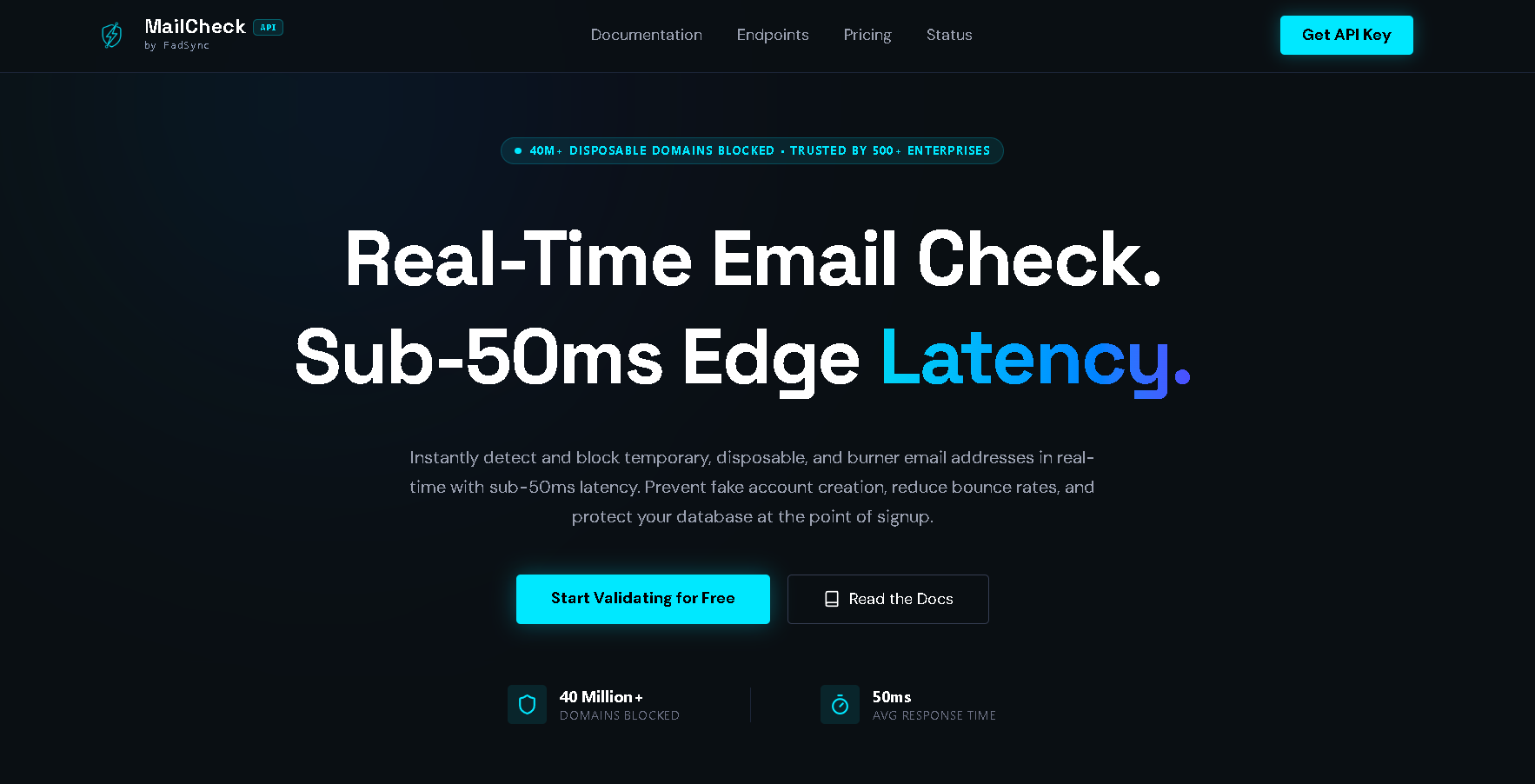
MailCheck provides an email verification API focused on real-time validation and disposable email detection. Its developer materials describe checks involving syntax, DNS/MX information, and disposable-domain intelligence. (mailcheck.fadsync.com)
Email Validation API vs Email Verification API
The easiest way to understand the difference is to think about the depth of the checks rather than the terminology.
| Feature | Email Validation API | Email Verification API |
|---|---|---|
| Syntax checking | Usually | Usually |
| Domain checking | Often | Often |
| DNS checks | Provider-dependent | Often |
| MX checking | Provider-dependent | Often |
| Disposable detection | Provider-dependent | Common |
| Catch-all information | Provider-dependent | Provider-dependent |
| Risk signals | Provider-dependent | Often |
| Real-time use | Yes | Yes |
| API integration | Yes | Yes |
There isn’t a universal industry definition that says every validation API must perform one exact set of checks and every verification API must perform another.
That’s why features matter more than the label.
Is Email Validation the Same as Email Verification?
Not necessarily.
Consider this address:
customer@example.comA basic syntax validator might determine:
The format is valid.
But that doesn’t necessarily tell you:
- Whether
example.comexists - Whether the domain has MX records
- Whether the domain is disposable
- Whether the address has other risk characteristics
A broader verification process can provide additional information.
So you can think of the relationship like this:
Email Validation
       ↓
Basic / Technical Checks
       ↓
Email Verification
       ↓
Broader Evaluation
But again, the exact boundary depends on the provider.
Why Developers Confuse These Terms
The terminology is confusing because companies use “validation” and “verification” differently.
One provider might call its product an email validation API while performing DNS, MX, and disposable-domain checks.
Another might call essentially similar functionality an email verification API.
Therefore, searching for one phrase shouldn’t automatically exclude services using the other phrase.
Instead, compare:
- What checks are performed?
- What results are returned?
- How fast is the API?
- What are the rate limits?
- How does pricing work?
- What documentation is available?
- How current is disposable-domain intelligence?
These questions are much more useful than the product name alone.
Syntax Validation: The First Layer
Email syntax is the most basic part of the process.
A signup form can determine whether an input looks like:
user@example.comrather than:
user@This can often happen directly in the browser without making an external API request.
That’s useful because it provides immediate feedback.
For example:
Please enter a valid email address.
However, syntax validation has significant limitations.
A syntactically valid address can still be:
- Nonexistent
- Associated with a disposable provider
- Hosted on a problematic domain
- Catch-all
- Otherwise unsuitable for your business requirements
For developers interested in the technical side of syntax, see the email validation regex and RFC 5322 guide.
Domain and DNS Validation
The next layer involves the domain.
Suppose the user submits:
user@example.comThe application can examine:
example.comand determine whether the domain appears to exist.
DNS checks can provide additional information about the domain’s configuration.
One particularly relevant record is the MX record, which identifies mail-exchange servers associated with the domain.
A simplified workflow is:
Email
 ↓
Extract Domain
 ↓
DNS Lookup
 ↓
MX Check
 ↓
Return Result
For a deeper explanation, developers can read the MX record lookup and DNS email deliverability guide.
Disposable Email Detection
Disposable email detection is another important distinction for many SaaS applications.
A temporary email address can be syntactically valid and use a technically configured domain.
Yet your business may still want to prevent that address from being used for registration.
For example:
user@temporary-domain.exampleThe address may pass basic validation but be identified as a disposable domain.
This is why businesses should consider what the verification service actually detects, rather than assuming that “valid” means “good for signup.”
MailCheck provides dedicated disposable email detection as part of its email validation capabilities.
Email Verification for SaaS Signup Forms
For SaaS applications, the distinction becomes particularly important during registration.
A typical signup process may look like:
User enters email
       ↓
Syntax validation
       ↓
Email verification
       ↓
Disposable check
       ↓
Trial eligibility
       ↓
Create account
This approach lets your application make decisions before granting trial resources.
For example, your business rules could be:
Invalid → Reject

Disposable → Restrict

Previously used for trial → No new trial

Valid → Continue
Email verification isn’t a complete anti-abuse system, but it can be an important part of one.
For more information, see the guide on preventing free-trial abuse with email verification.
Email Validation API for Signup Forms
An email validation API can also be used directly during registration.
The architecture might look like:
Signup Form
     ↓
Your Backend
     ↓
Email Validation API
     ↓
Result
     ↓
Application Rules
     ↓
Create Account
This can be particularly useful when your application needs to validate thousands of registrations without implementing every check internally.
For example, the backend could receive:
{
  "email": "customer@example.com"
}
and send that address to the verification service.
The API returns structured information that your backend evaluates.
For MailCheck’s current API capabilities and integration details, see the MailCheck API documentation.
Do You Need an API or Just Regex?
For a simple form, you may only need basic syntax validation.
For example:
Contact form
+
Basic input checking
may not require an external verification API.
But an API becomes more valuable when email quality affects business operations.
Consider using deeper verification when you need to:
- Prevent disposable registrations
- Reduce low-quality leads
- Improve signup data
- Protect free trials
- Validate large datasets
- Check domain infrastructure
- Automate verification at scale
The question isn’t:
“Should I use an API?”
The better question is:
“What level of email intelligence does my application actually need?”
When Should You Use an Email Verification API?
An email verification API makes sense when the result affects an important application decision.
SaaS signup
Determine whether an address should receive an account or trial.
Lead capture
Identify potentially problematic addresses before adding them to your CRM.
Marketplace registration
Improve the quality of new user records.
E-commerce
Validate customer data during account creation or checkout.
API platforms
Protect usage quotas from low-quality registrations.
Existing databases
Verify large numbers of existing addresses through bulk workflows.
For large datasets, a bulk email verification and batch API architecture can be more appropriate than validating records individually through a signup flow.
Real-Time Email Validation vs. Confirmation Email
Another important distinction is between API verification and email confirmation.
These are not the same thing.
API Verification
Your application sends the email address to a verification service.
Email
 ↓
Verification API
 ↓
Validation Result
Email Confirmation
Your application sends a message to the address and asks the user to confirm access.
Email
 ↓
Send Confirmation
 ↓
User Opens Email
 ↓
Clicks Confirmation
The two approaches can complement each other.
For example:
API Verification
      ↓
Signup Accepted
      ↓
Confirmation Email
      ↓
User Confirms
The API provides automated technical signals, while confirmation establishes that the user can access the mailbox.
How Accurate Is an Email Verification API?
No email verification system should be treated as a perfect prediction of whether a message will ultimately reach a human recipient.
Email infrastructure is complicated.
Domains can change configuration, mail servers can behave differently, and some verification techniques provide signals rather than absolute certainty.
Therefore, developers should think in terms of decision support.
For example:
Verification Result
       ↓
Business Rules
       ↓
Accept / Reject / Review
The API provides information.
Your application decides what that information means for your product.
What Should You Look for in an Email Verification API?
When comparing providers, evaluate the actual capabilities.
1. Validation Signals
Does the service provide syntax, domain, DNS, MX, disposable, and other relevant checks?
2. Response Speed
If the API is used during signup, latency matters.
MailCheck currently advertises low-latency validation and a sub-50ms target response time. (mailcheck.fadsync.com)
3. API Documentation
Look for clear documentation, examples, authentication instructions, response schemas, and error handling.
4. Scalability
Make sure the API can accommodate your expected request volume.
5. Rate Limits
Understand how many requests your application can make and what happens when the limit is reached.
6. Pricing
Calculate the effective cost at your actual monthly volume rather than looking only at the entry-level plan.
You can review the current MailCheck pricing when evaluating the service.
7. Privacy
Understand how submitted email addresses are processed and retained.
A Practical Architecture for Developers
If you’re still deciding between email validation and verification, you can use a layered approach.
               USER SIGNUP
                    ↓
             Basic Validation
                    ↓
             Your Backend
                    ↓
          Email Verification API
                    ↓
       ┌────────────┼────────────┐
       ↓            ↓            ↓
     Domain       MX Check    Disposable
       ↓            ↓            ↓
       └────────────┼────────────┘
                    ↓
              Business Rules
                    ↓
            Accept / Reject
                    ↓
              Create Account
This approach separates technical checks from business decisions.
Email Verification API vs Email Validation API: Which One Should You Choose?
The answer depends on what you’re trying to accomplish.
Choose basic validation when:
- You only need input formatting checks
- Your application has minimal signup risk
- You don’t need domain intelligence
- You want to avoid unnecessary external requests
Choose deeper verification when:
- Email quality affects your business
- You need disposable email detection
- You want DNS/MX information
- You’re protecting SaaS trials
- You process large volumes of email addresses
- You need automated verification at signup
For many modern SaaS applications, the best approach isn’t choosing between the words “validation” and “verification.”
Instead, choose a service that provides the specific signals your application requires.
Best Practices for Email Validation and Verification
Validate early
Perform lightweight checks before unnecessary processing.
Verify on the backend
Don’t rely exclusively on client-side validation.
Don’t expose API credentials
Keep private keys on your server.
Use disposable detection where appropriate
Especially for SaaS products with free trials or limited resources.
Don’t automatically reject every uncertain result
Define rules based on your actual business requirements.
Handle API errors
Use sensible timeouts, retries, and fallback behavior.
Monitor your results
Track validation failures, disposable detections, API errors, and signup conversion.
Keep your data clean
For existing databases, consider periodic verification rather than relying only on signup-time checks.
Final Verdict: Email Verification API vs Email Validation API
So, what’s the difference between an email verification API and an email validation API?
The answer isn’t simply that one is “basic” and the other is “advanced.”
The terminology varies between providers.
In general, email validation often refers to determining whether an address meets certain technical or structural requirements, while email verification can describe a broader evaluation using additional signals.
But the real difference comes down to the capabilities behind the API.
Before choosing a provider, look at whether it supports the checks you actually need:
Syntax
  +
Domain
  +
DNS/MX
  +
Disposable Detection
  +
Other Signals
For a basic contact form, simple syntax validation may be enough.
For a SaaS signup system, an email verification API with disposable-email detection and additional domain signals can provide much more useful information before an account is created.
For developers evaluating an API-based solution, you can test MailCheck’s email validation service and review its API documentation to see how its verification workflow can fit into your application.
Ultimately, don’t choose an API because its marketing calls it “verification” or “validation.” Choose based on the actual checks, response quality, performance, pricing, documentation, and integration requirements of your application.