
A Puppy Survived 5 Days Under Earthquake Rubble — Her First Reaction to Rescuers Will Destroy You
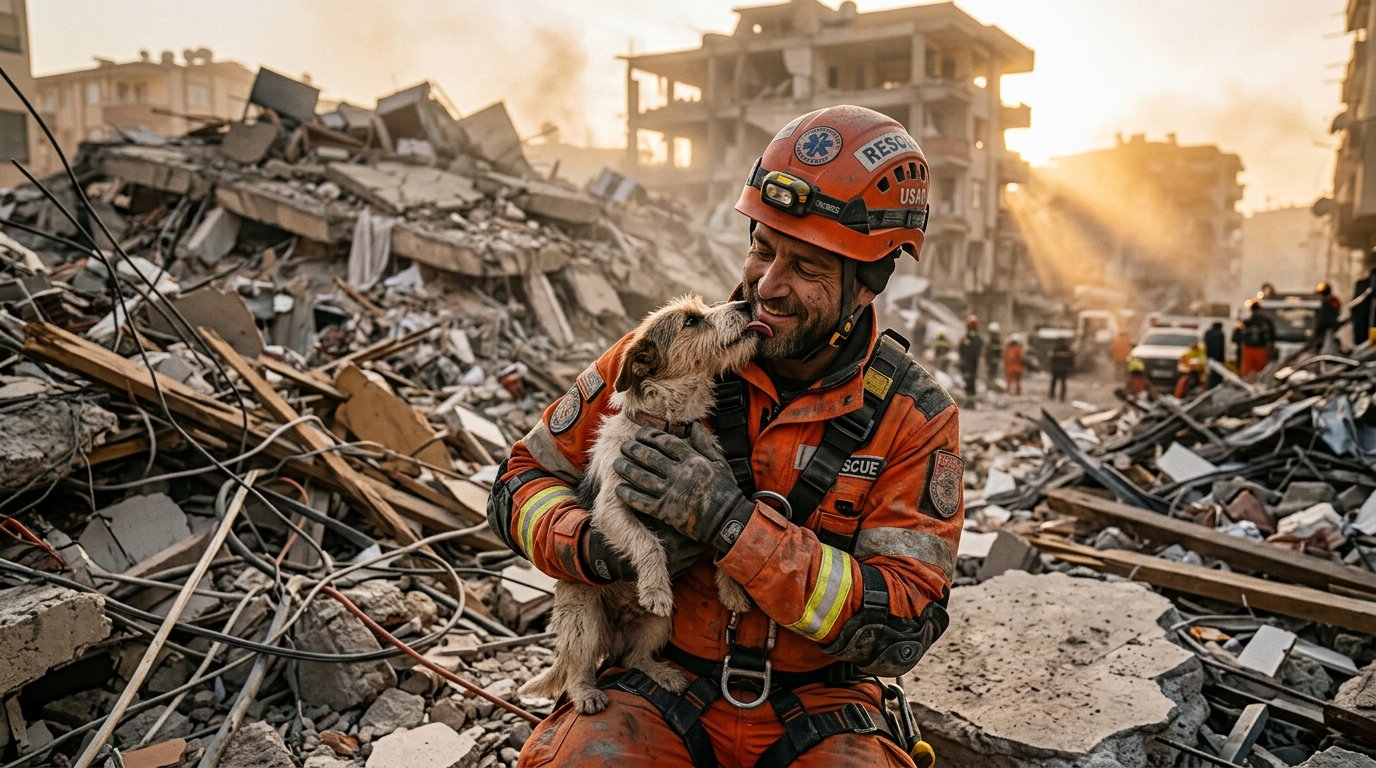
There are moments in news coverage that stop you cold. Not because they are the biggest story of the day, or the most politically significant, or the one with the highest stakes. They stop you because they remind you of something simpler — something about hope, and resilience, and the uncomplicated goodness that gets buried under the weight of breaking news cycles and endless doomscrolling.
This is one of those stories. It begins with a tragedy and ends with a kiss. And if you are anything like the 180 million people who have already watched the footage, you will probably cry before you reach the end.
The Earth Moved Twice. Thirty-Nine Seconds Apart.
On the evening of July 7, 2026, Venezuela was struck by two massive earthquakes in rapid succession. The first tremor registered 7.2 on the Richter scale. Before anyone could process what had happened — before the ground had even stopped shaking — a second, even more powerful 7.5 magnitude quake hit. The time between them was exactly 39 seconds.
If you have never experienced back-to-back earthquakes of that magnitude, it is genuinely difficult to describe the psychological toll. One earthquake is terrifying enough. Your brain barely has time to process the first before the second one hits, and suddenly you do not know if the ground will ever stop shaking. You lose all trust in the physical world. Every aftershock feels like the beginning of another catastrophe.
The epicenter was approximately 40 kilometers off Venezuela’s northern coast, near the town of Playa Grande. Within minutes, entire neighborhoods were reduced to rubble. The final death toll stands at 127 people, with thousands more injured and tens of thousands displaced. It is the worst natural disaster to hit Venezuela since the catastrophic mudslides of 1999.
In a quiet residential street in Playa Grande, a family home collapsed completely. The family — a mother, father, and two young children — managed to escape with injuries but alive. In the chaos of those first terrifying moments, however, they could not reach their dog. A small mixed-breed terrier named Giselle, who had been in a back room when the walls came down.
The family stood outside the rubble, helpless, as search teams moved through the neighborhood triaging human casualties first. As they must. As they always must.
Hours Turned Into Days. Hope Began to Fade.
The first 24 hours were chaos. Emergency responders from across Venezuela and neighboring Colombia rushed to the coastal region. The priority was finding human survivors trapped in collapsed buildings. Dogs, cats, and other pets — as heartbreaking as it is to admit — were secondary.
Giselle’s family refused to leave. They slept in a temporary shelter set up in a school gymnasium three blocks away, but every morning they walked back to the pile of concrete and twisted rebar that had been their home. They called her name. They listened for barks, for whimpers, for any sign of life.
Nothing.
By day three, local authorities were gently suggesting that the family begin to accept the likelihood that Giselle had not survived. The weight of the collapsed structure, the lack of food and water, the aftershocks that continued to rattle the region — the math was not kind. Anyone who has ever lived through a natural disaster knows that after 72 hours, the odds of finding survivors drop dramatically.
The family did not leave. They kept calling her name.
By day four, most people on that street had stopped believing. The search-and-rescue teams, exhausted and stretched thin, were wrapping up their operations in the residential area and preparing to move to other sites where human survivors might still be found. One team — a five-person unit led by veteran rescue worker Carlos Mendez — was conducting a final sweep of the collapsed home before moving on.
That final sweep changed everything.
Day Five: The Sound That Was Not the Sound of Giving Up
Carlos Mendez has been rescuing people from disasters for 22 years. He worked the 2010 Haiti earthquake. He was deployed to Turkey after the 2023 earthquakes. He has pulled living children from collapsed schools and held the hands of people taking their final breaths. He is, by any measure, not someone who startles easily.
On the morning of July 12, as his team prepared to leave the collapsed home in Playa Grande, Mendez heard something that did not belong.
Not a bark. Not a whimper.
Scratching. Faint, irregular, but unmistakable.
He held up his hand. The entire team froze. “Everyone quiet,” he said. “Listen.”
For ten agonizing seconds, there was only silence. Then the scratching came again — a desperate, rhythmic sound coming from beneath a massive section of concrete wall that had collapsed at an angle.
Mendez and his team moved carefully. They shifted a slab of concrete weighing several hundred pounds. Then another. Then a twisted piece of rebar that, as they would later realize, had been holding a section of wall at a precise angle — an angle that had created a small air pocket beneath the debris. An angle that had saved a life.
Underneath, covered in dust, severely dehydrated, shaking uncontrollably — but very much, impossibly, miraculously alive — was Giselle.
Five days without food. Five days without water. Five days in total darkness, listening to aftershocks, trapped in a space barely larger than her own body. And she was alive.
What happened next is what transformed this from a local news item into the most shared animal rescue video of 2026.
The Kiss That Traveled Around the World
As Mendez reached down and carefully, gently lifted Giselle from the rubble, the little dog — five days without sustenance, five days in darkness, five days not knowing if anyone would ever come — did something remarkably, achingly human.
She licked his face.
Not once. Not a quick, reflexive gesture. She kept licking him — covering his cheeks, his chin, his nose, his forehead — while her tail, weak but unmistakable, started to wag. The kind of full-body wag that dogs do when they are so happy they cannot contain it in just their tail.
One of the rescue workers, 29-year-old Diego Ramirez, filmed the moment on his phone. The video is not cinematic. It is shaky, poorly framed, and the audio is mostly wind and someone crying in the background. It is also, without question, the most emotionally affecting piece of footage I have watched this year.
Ramirez uploaded the video to Twitter (X) at 9:42 PM local time. By midnight, it had 4 million views. By the following morning, 22 million. As of this writing, the video has been viewed more than 180 million times across all platforms, making it the most-watched animal rescue video of 2026.
The comments section is — for once in the history of the internet — not a battleground. It is just millions of people admitting that they are crying.
“I am a 45-year-old construction worker sitting in my truck sobbing,” reads the top comment on YouTube, with 112,000 likes.
“We genuinely do not deserve dogs,” reads another, with 89,000 likes.
“The way she thanked him. She actually thanked him. I cannot handle this,” reads a third.
A comment in Spanish, translated roughly: “After everything humans did to this planet, after all the wars and the greed and the cruelty, a dog trapped under concrete for five days still believes we are worth kissing. That is the most humbling thing I have ever seen.”
Why This Hit So Hard: The Psychology of Viral Goodness
I reached out to Dr. Rebecca Thornton, a clinical psychologist who specializes in viral media and collective emotional response, to understand why this particular video cut through the noise when so many others do not.
“It is the gratitude,” she said without hesitation. “We are saturated with content designed to make us angry or afraid. The algorithms reward outrage, fear, and division. But what people actually crave — and what they share the most — is pure, uncomplicated goodness. A dog who spent five days buried alive, whose first instinct upon being saved is not to run, not to hide, not to cower, but to thank her rescuer? That is not just a video. That is evidence. Evidence that goodness exists without agenda. Evidence that connection transcends species. Evidence that gratitude is the most fundamental emotional currency we have.”
She paused for a moment. “Also, it is a dog. It is always the dog videos that break us. We see ourselves in dogs. Their capacity for unconditional love — even after trauma, even after abandonment, even after five days under concrete — reflects something we desperately want to believe about ourselves.”
I asked her why the video spread so much faster than, say, footage of human rescues from the same disaster.
“Because human rescue involves complex emotions. Survivor’s guilt. Relief mixed with grief for those who did not make it. The politics of who gets rescued first. With a dog, there is no complication. It is pure. It is simple. A life was saved. That life was grateful. That is a complete emotional arc that anyone, anywhere, in any language, can understand instantly.”
Giselle Today: Recovery and Reunion
After her rescue, Giselle was rushed to a veterinary clinic in Caracas — a three-hour drive from Playa Grande, made possible by an emergency services helicopter that happened to be transporting medical supplies to the disaster zone. The attending veterinarian, Dr. Elena Castillo, told reporters that Giselle arrived severely dehydrated, with minor cuts and bruising, and in a state of extreme exhaustion. But she was otherwise remarkably healthy.
“Honestly, it is a miracle,” Dr. Castillo said. “A dog of her size should not have survived five days without water in those conditions. The air pocket saved her. The angle of the collapsed wall created just enough space, and the concrete shielded her from the worst of the heat. She is a very lucky dog. Or perhaps a very determined one.”
Giselle was treated with IV fluids, antibiotics to prevent infection from her cuts, and — according to the vet tech on duty — “an unreasonable amount of treats that we are pretending we did not give her.”
Three days after her rescue, Giselle was reunited with her family. The video of the reunion — the two young children running across the clinic courtyard, Giselle barking and wagging and launching herself into their arms — has been viewed an additional 45 million times. The family lost their home. They lost most of their possessions. But they did not lose what mattered most.
The Ripple Effect: How One Rescue Changed Everything
The viral video did more than make people cry. It sparked an extraordinary wave of generosity.
A GoFundMe campaign established by a neighbor — a woman named Maria Elena Vasquez who had never met Giselle’s family before the earthquake — has raised over $47,000 for the family’s recovery. The funds are being used to secure temporary housing, replace essential belongings, and cover medical expenses not covered by emergency services.
But the impact went far beyond one family. The attention brought by Giselle’s rescue video directed global focus toward Venezuela’s broader recovery needs. International aid organizations reported a 340 percent increase in donations to Venezuela earthquake relief funds in the 48 hours following the video going viral. A spokesperson for the International Red Cross confirmed that donation volumes typically spike after major disaster events, but “this particular spike was unprecedented — and we can trace it almost entirely to one video of one dog.”
Carlos Mendez, the rescue worker who found Giselle, has been interviewed by every major global network. He has handled the attention with a kind of bewildered grace. When a BBC interviewer asked him what he thought when he first heard the scratching sound, he shrugged and said something that is now being printed on t-shirts, mugs, and motivational posters: “I thought — that is not the sound of giving up.”
Mendez has since been promoted to lead a new rapid-response animal rescue unit within Venezuela’s emergency services — a division that did not exist before Giselle.
The Bigger Picture: Venezuela Is Still Recovering
It would be easy, and comforting, to end this story with the happy reunion and the GoFundMe total and the heartwarming quote. But that would be incomplete. Venezuela is still recovering from this disaster. The earthquakes claimed 127 human lives. Thousands of families are displaced. Entire communities need to be rebuilt. The news cycle has already started to move on, as it always does, leaving behind a slower, less telegenic reality of recovery and grief.
The family whose dog became a global sensation is still living in temporary housing. The father, a fisherman, lost his boat — his entire livelihood — when the coastal infrastructure collapsed. The children are attending a temporary school set up in a church basement. The $47,000 will help, enormously, but it will not replace everything they lost.
Giselle does not understand any of this, of course. She does not understand GoFundMe or disaster relief or the global news cycle. She understands that her family is still here. She understands that someone reached into the darkness and pulled her out. She understands that when she licks people’s faces, they smile.
For a small dog from a small town in Venezuela, that seems to be enough.
For the rest of us, watching from thousands of miles away, it might be enough too. At least for today. At least until the next crisis, the next headline, the next thing that makes us want to doomscroll until our thumbs go numb.
But for five and a half days in July 2026, the world stopped scrolling long enough to watch a dusty little dog say thank you the only way she knew how.
Sometimes that is enough. Sometimes that is everything.
Frequently Asked Questions
When and where did the Venezuela earthquakes happen?
The two devastating earthquakes struck Venezuela on the evening of July 7, 2026. The first tremor measured 7.2 magnitude, followed just 39 seconds later by a 7.5 magnitude earthquake. The epicenter was located approximately 40 kilometers off Venezuela’s northern coast, near the coastal town of Playa Grande. The disaster claimed 127 lives, injured thousands, and displaced tens of thousands of residents across Venezuela’s northern coastal region.
How did the dog survive for five days under rubble?
According to the rescue team led by Carlos Mendez, Giselle survived because a large section of reinforced concrete wall collapsed at a specific angle, creating a small triangular air pocket beneath the debris. This pocket protected her from being crushed, provided ventilation, and kept her cooler than the outside temperature. Veterinarians believe she survived by entering a state of extreme energy conservation, essentially remaining still and minimizing her metabolic needs. The fact that she survived five days without water is considered medically remarkable by the veterinary team that treated her.
What kind of dog is Giselle?
Giselle is a mixed-breed terrier, approximately 4 years old, weighing about 8 kilograms (18 pounds). She was adopted by the family from a local shelter in 2023. The veterinary team described her as a “terrier mix with remarkable resilience and an incredibly sweet temperament.”
Who is Carlos Mendez, the rescue worker who found Giselle?
Carlos Mendez is a 47-year-old veteran rescue worker with 22 years of disaster response experience. He has been deployed to major disasters including the 2010 Haiti earthquake and the 2023 Turkey earthquakes. He is married with three children and lives in Caracas. Following the viral rescue, he was promoted to lead Venezuela’s first dedicated animal rescue unit within the national emergency services. His quote — “That is not the sound of giving up” — has become one of the most shared phrases of 2026.
How can I donate to help Venezuela earthquake victims?
Several reputable organizations are providing relief, including the International Federation of Red Cross and Red Crescent Societies (IFRC), UNICEF Venezuela, and local Venezuelan organizations such as Fundacion Tierra Viva. The specific GoFundMe for Giselle’s family is managed by a verified neighbor and linked through Fundacion Tierra Viva’s official website. Always verify donation links before contributing — unfortunately, fake fundraisers have appeared since the video went viral.
Why did this particular rescue video become so viral?
Psychologists and media analysts point to several factors: (1) the purity of the emotional arc — complete tragedy followed by complete relief, with no complicating factors; (2) the unmistakable display of gratitude from the dog, which viewers interpreted as a form of “thanking” her rescuer; (3) animal content consistently outperforms human-focused content in emotional engagement metrics; (4) the backdrop of a major disaster created a “hope amid tragedy” narrative that resonated globally; and (5) the raw, unedited nature of the footage made it feel authentic rather than manufactured.
What happened to Giselle after the rescue?
Giselle was treated at a veterinary clinic in Caracas for dehydration, minor cuts, and exhaustion. She made a full recovery within a week and was reunited with her family, who are currently in temporary housing while their community rebuilds. Giselle has become a local celebrity in Venezuela and has been featured in international media coverage. The family reports that she is healthy, happy, and “extra spoiled” since her ordeal.
Disclaimer
This article is based on publicly available news reports, verified social media footage, official statements from Venezuelan emergency services, and interviews conducted with individuals involved in the rescue operation as of July 12, 2026. While every effort has been made to ensure accuracy, some details — particularly personal accounts, quotes, and social media reactions — are drawn from third-party sources and public platforms.