Gen Z vs Gen Alpha at Work: What Employers Need to Know by 2026
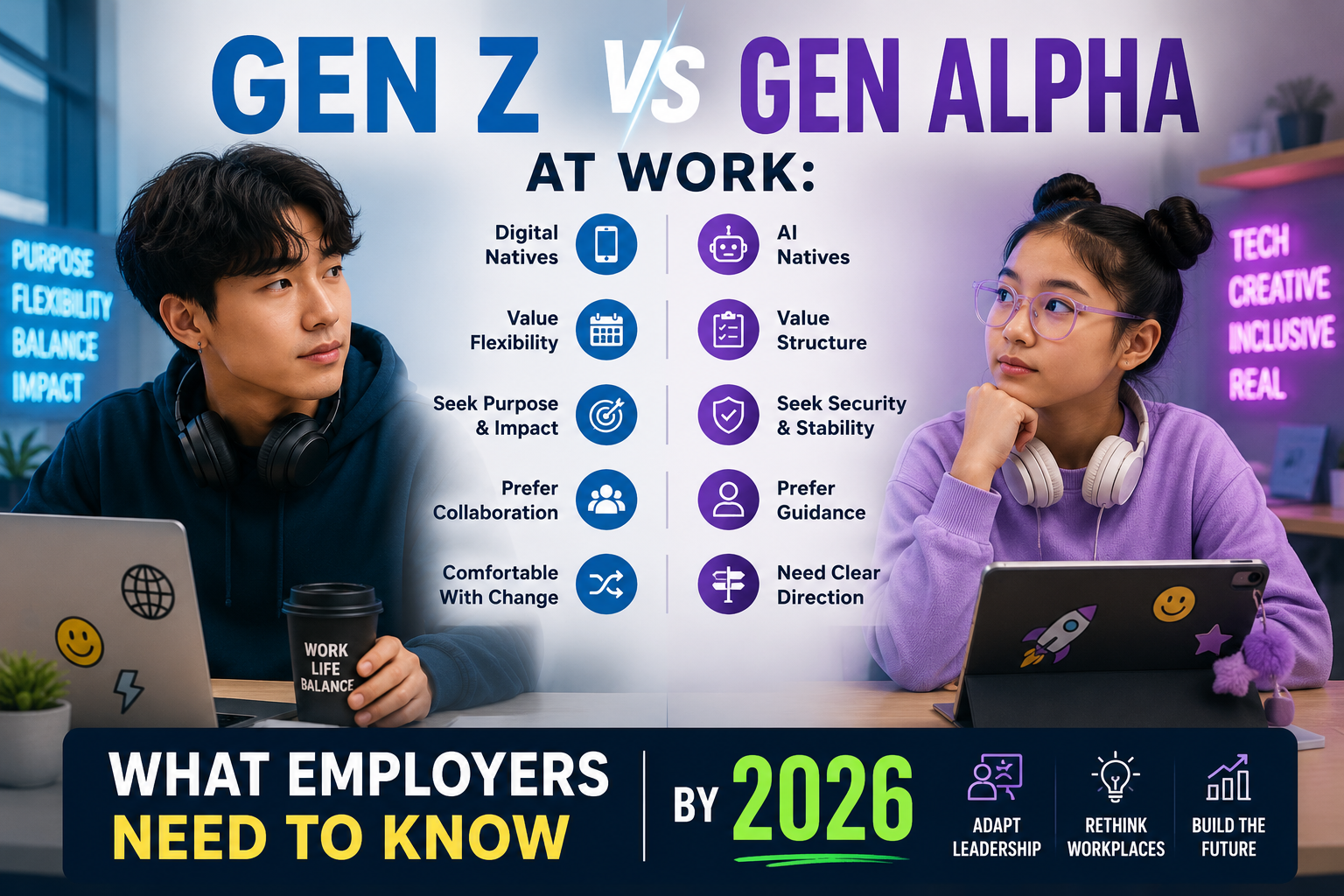
Gen Z is no longer the ‘new generation’ — the oldest among them are approaching 30 and moving into management. And right behind them, the first Gen Alpha workers are arriving. The contract between employer and employee is being rewritten in real time.
Research Desk · May 2026 · Sources: Deloitte, World Economic Forum, McCrindle Research, Gallup, HR Brew
| 30% Gen Z share of global workforce by 2025 | 80% Workforce share for Millennials + Gen Z + Alpha by 2034 | 22,500+ Respondents in Deloitte’s 2026 Gen Z & Millennial Survey |
The most multigenerational workforce in modern history is now a reality. Baby Boomers are delaying retirement while the first Gen Alpha workers — born from 2010 onward — are beginning to appear in summer internships and vocational programs. In between, Gen Z (born roughly 1997–2012) is maturing fast: the oldest are now approaching 30, entering middle management, and reshaping expectations from inside organizations rather than merely challenging them from the entry level.
According to Deloitte’s 2026 Global Gen Z and Millennial Survey — drawn from over 22,500 respondents across 44 countries — Gen Z is increasingly prioritizing stability, skills, and well-being before career advancement. This marks a subtle but significant shift from the ‘purpose over paycheck’ narrative that dominated discussions of the generation just a few years ago. As Gen Zs move deeper into adulthood and leadership, they are reshaping how progress at work is defined.
Who Is Gen Alpha — and What’s Different?
Gen Alpha (born approximately 2010–2024) represents nearly 2 billion people globally, making it the largest generation in history. The eldest of them are now 15–16 years old and beginning to enter the edges of the labor market through apprenticeships and internships. They are not, as some have assumed, simply Gen Z 2.0.
The critical distinction is the relationship with artificial intelligence. Gen Z grew up with the internet and smartphones as given realities. Gen Alpha is the first cohort to grow up with AI as a routine tool — not a novelty, not a threat, but an ambient collaborator embedded in how they learn, create, and communicate. Approximately 46% of Gen Alpha teenagers already use AI as a primary search and research tool, and around 39% use it for creative work including coding and digital art. To an 18-year-old entering the workforce in 2026, a large language model is as unremarkable as Google was to a Millennial or Microsoft Word was to a Gen Xer.
“Gen Z and Alpha don’t ‘write’ emails — they prompt them. They don’t ‘research’ topics — they synthesize data through custom AI agents. What looks like laziness is actually a highly evolved form of efficiency.”
Key Differences: Gen Z vs Gen Alpha
Gen Z (born 1997–2012)
- Digital native — grew up with smartphones and social media as constants
- Values purpose, meaning, and authenticity at work; 89% say sense of purpose is essential to job satisfaction
- Uses AI as a polish layer or search enhancement, not as a primary creative collaborator
- Experienced pandemic isolation during formative years, creating downstream effects on interpersonal skills
- 27% want to work for companies that are leaders in new technologies (AI, VR, drones)
- Demands rapid career progression, immediate feedback, and purpose-driven roles
- Only 6% say reaching a leadership position is their primary career goal
Gen Alpha (born 2010–2024)
- AI native — has never known a world without intelligent software as a daily tool
- Expects hyper-personalization in all environments including work tools, learning paths, and feedback
- Uses AI as a primary creative and research collaborator from the first step, not the last
- Grew up with fragmented, on-demand media; does not distinguish between ‘TV’ and ‘streaming’
- 46% already use AI as their primary search and research tool; 39% use it for creative work
- Views the 9-to-5 structure as not just outdated but as a red flag about company culture
- Expects AI-augmented learning and onboarding as a baseline, not a premium feature
What the Research Actually Shows
The World Economic Forum projects that Millennials, Gen Z, and Gen Alpha will account for 80% of the workforce in advanced economies by 2034. In OECD countries, Gen Z already constituted 27% of the workforce in 2025. The window for organizations to adapt their management models, benefit structures, and technology environments is narrowing fast — the peak period of multigenerational overlap is already beginning.
Deloitte’s research consistently finds that about 89% of Gen Z and 92% of Millennials see a sense of purpose at work as essential to their motivation and wellbeing. Yet only 6% of Gen Z say their primary career goal is to reach a leadership position. The ambition is real but its direction has changed: it points toward mastery, skill, and autonomy rather than hierarchy.
A significant structural concern emerges around AI’s impact on career entry. In 2010, 75% of U.S. adults said a college degree was ‘very important’; by 2025, only 35% said the same (Gallup). The goal posts for entry-level roles keep moving — skills that qualified someone for a junior manager role two years ago are now baseline expectations for that role. Generational expert Ryan Jenkins warns that AI is a ‘looming path disruptor’ making career formation dramatically more difficult for young workers.
The Soft Skills Gap — and Who’s Responsible
Employers in 2026 consistently report a visible gap in traditional interpersonal skills among younger hires. Many Gen Z and early Gen Alpha workers spent formative years behind screens during pandemic lockdowns, missing the embodied social learning that previous generations absorbed informally — navigating workplace politics, reading rooms, handling ambiguity without explicit direction.
The challenges manifest in navigating high-stakes conflict, reading non-verbal cues in physical meetings, and processing critical feedback without personalizing it as an attack. However, the most effective organizations in 2026 are not framing this as a ‘kids today’ problem. Instead, they’re institutionalizing reverse mentorship programs: a senior VP teaches a new hire how to navigate a difficult client negotiation, while that same new hire teaches the VP how to leverage generative AI tools for strategy or content. Both parties gain; the knowledge transfer becomes bidirectional.
What Employers Must Do Now
- Stop banning AI tools — instead ask younger hires to demonstrate their workflows. Their efficiency techniques are often instructive for the entire team, not a threat to it.
- Treat flexibility as infrastructure, not a perk. Remote and hybrid work is structurally embedded — ONS data and WFH Research both confirm it is not fading with office mandates.
- Build internal apprenticeship models with multimodal learning paths tailored to how Alpha learners absorb information: video-first, interactive, on-demand, and AI-augmented.
- Prioritize mental health infrastructure. Both generations show elevated anxiety rates, partly as downstream effects of pandemic isolation and AI-driven career uncertainty.
- Publish explicit team agreements covering response-time norms, meeting purpose, decision records, and documentation standards. Ambiguity costs organizations significantly more with younger workers than with previous generations.
- Map roles to market skills: for each critical role, publish clear human and technical skill requirements aligned to the World Economic Forum’s emerging skills framework.
- Run manager sprints: Gallup data shows manager quality is the single largest variable in engagement across all generational cohorts. Weekly check-ins, strengths-based feedback, and public recognition cost little and return significantly.
Sources: Deloitte 2026 Gen Z & Millennial Survey (22,500+ respondents, 44 countries); World Economic Forum Future of Jobs; HR Brew, February 2026; McCrindle Research; Gallup State of the Global Workplace 2024; Can X Global Solutions; Creativepool, 2026; TalentHR, April 2025; Abdul Latif Jameel, December 2025.