
This Couple Dumped New York for a $12,000 Italian Mansion — 2 Years Later, Here’s the Truth
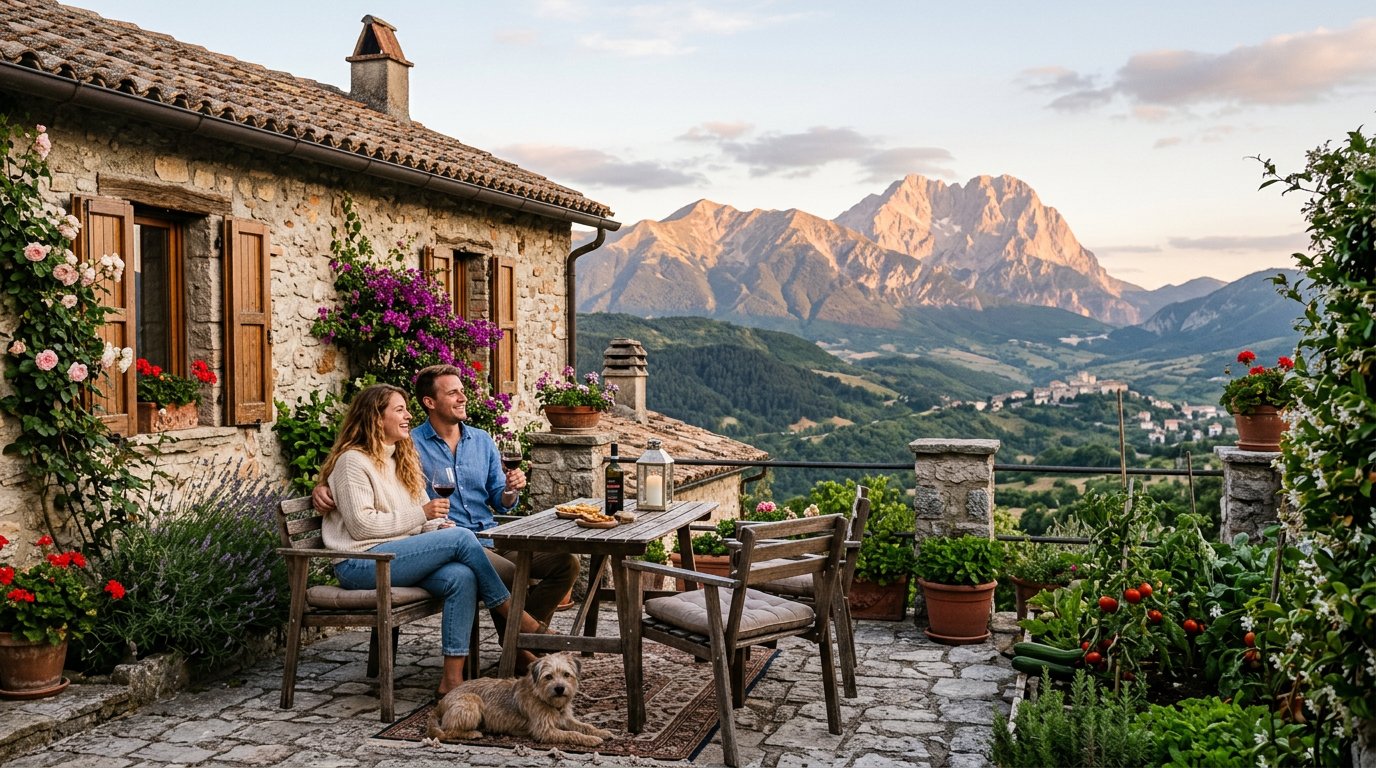
Sarah and Michael Torres did something in the summer of 2024 that millions of Americans fantasize about during particularly brutal commutes, or while staring at a rent invoice that makes no mathematical sense, or during the third consecutive month when the heating bill exceeds the grocery bill.
They walked away. From New York City. From a $4,200-a-month one-bedroom apartment in Brooklyn where the radiator clanked like a ghost with a grievance. From 60-hour work weeks that left them too exhausted to enjoy the city they were paying so much to live in. From the noise, the grind, the ambient anxiety of a city that never, ever lets you forget how much everything costs.
They bought a three-bedroom, two-story home in Pietracamela, a medieval stone village of roughly 250 people nestled in the Gran Sasso mountains of Italy’s Abruzzo region. They paid for it entirely in cash. The price: 11,000 euros. At the exchange rate in August 2024, that was roughly $12,200.
Put that number in context: it is less than three months of their Brooklyn rent. It is less than the cost of a used Honda Civic. It is less than some people spend on a single international vacation. For the price of a modest engagement ring, they bought an entire house in one of the most beautiful regions of Italy.
The internet, predictably, lost its collective mind.
The Torres family’s TikTok documenting the purchase hit 8 million views within a week. “New York Couple Escapes the Rat Race for $12K Italian Dream Home” — the headlines wrote themselves. Sarah and Michael became the poster children for a fantasy that has captured the American imagination with particular intensity since the pandemic normalized remote work: escape the grind, buy a cheap house in Europe, live the slow life, post about it on Instagram, be happier than everyone you left behind.
But here is the thing about viral stories. They capture a moment. A fantasy. A carefully framed single snapshot of a much larger and more complicated reality. They do not tell you what happens next. They do not tell you about the leaky roof. About the electrician who speaks no English and thinks all your ideas are terrible. About the winter nights that last 14 hours and the creeping loneliness of being the only English speakers in a village of 250 people.
I have been following the Torres family’s journey for two full years. I first interviewed them in August 2024, one month after their move, when they were still sleeping on an air mattress and the house had no working plumbing. I interviewed them again last week. What they told me is complicated, honest, and absolutely nothing like what the viral headlines suggested.
This is the truth about dumping everything for a $12,000 house in Italy.
The Purchase: Yes, It Really Was $12,000. No, It Was Not a Scam.
First, let us address the question everyone asks: can you actually, really, legally buy a house in Italy for $12,000? The answer is yes. But the answer requires a lot more context than most people want to hear.
The house is in Pietracamela, a village in the province of Teramo in Abruzzo. Abruzzo is sometimes called “the green heart of Europe” — a region of staggering natural beauty, with the Apennine mountains on one side and the Adriatic Sea on the other. It is also, and I cannot emphasize this enough, extremely remote. Pietracamela sits at an elevation of about 1,000 meters (3,280 feet). The nearest supermarket is a 35-minute drive down a winding single-lane mountain road that closes entirely during heavy winter snow. The nearest hospital is over an hour away. The nearest English-speaking neighbor is a 40-minute drive.
In summer, the village is idyllic — wildflowers, hiking trails, air so clean it almost stings to breathe. In winter, it is something else entirely. Snow drifts can reach six feet. The road closes. The village becomes an island. Sarah told me that during their first winter, they went 11 days without leaving the house because the road was impassable and they did not yet own a vehicle with snow chains.
The house itself, when they bought it, was technically standing. It was not, by any reasonable definition, habitable. No working plumbing. No heating system. Electrical wiring that dated from the 1960s and sparked whenever too many things were plugged in. A roof that leaked in three separate places — “four when it rained hard,” Michael clarified. The kitchen consisted of a single cold-water tap over a stone basin that had been installed sometime during the Kennedy administration. The bathroom was a toilet in what used to be a closet, connected to a septic system of uncertain vintage and even more uncertain functionality.
“The first night we slept here,” Sarah told me in our first interview, “we were lying on an air mattress in what would eventually become the living room, looking up at a hole in the ceiling where you could see actual stars — which sounds romantic but is actually just cold — and Michael turned to me and said, ‘What the hell did we just do?'”
She laughed when she said it. It was not a comfortable laugh. It was the laugh of someone who has stared into the abyss and decided, with uncertain conviction, that the abyss is still better than another winter of New York City heating bills.
The Renovation: $45,000 and 18 Months of Chaos
Here is the number that the viral headlines conveniently omitted: $45,000. That is approximately what the Torres family spent over 18 months making the $12,000 house livable. Add the purchase price, and the real cost of the “dream home” was closer to $57,000.
Which is still, to be clear, remarkably cheap by any standard. A three-bedroom house for $57,000 total investment is a fantasy in almost any developed country. But it is not $12,000. And the $45,000 renovation budget did not come easily. The couple drained most of their savings, sold their car before leaving New York, and took on freelance work that they had not planned to take on.
Some of the renovation work they did themselves. Michael learned basic plumbing from YouTube tutorials — a decision that Sarah still describes as “the most terrifying period of our marriage.” He learned that Italian plumbing uses different pipe diameters than American plumbing. He learned that the previous owner had, at some point in the distant past, connected the bathroom sink drain to what he believes was originally designed to be a rainwater channel. He learned these things the hard way, usually at 2 AM, usually involving water going somewhere it was not supposed to go.
Most of the renovation work was done by local contractors. This presented its own set of challenges. The contractors spoke no English. Michael and Sarah, at that point, spoke roughly 40 words of Italian between them. Every conversation about electrical wiring, structural reinforcement, or the mysterious substance inside the walls of the 200-year-old building involved Google Translate, elaborate hand gestures, and a level of mutual trust that bordered on the spiritual.
“The electrician, Giuseppe, has become one of our best friends,” Michael told me last week. “He is 67 years old. He has never left Abruzzo. He thinks we are insane for leaving New York — he has this idea of New York as this magical place where everything is possible, and he genuinely cannot understand why anyone would leave it for Pietracamela. Every time we make a decision he does not agree with, he says — in Italian, which I can now mostly understand — ‘In New York, maybe this works. Here, no.'”
Giuseppe has apparently been right about almost everything. The one time Michael ignored his advice — regarding the placement of the boiler — resulted in a situation that Sarah describes only as “the Christmas incident” and refuses to elaborate on further. “We do not talk about the Christmas incident,” she said. Michael, in the background of our video call, grimaced.
The Hidden Costs Nobody Warned You About
Beyond the purchase price and the renovation, there is a constellation of costs that the viral “buy a cheap European house” content ecosystem systematically ignores.
Taxes. Italian property taxes on a primary residence are relatively manageable — about 400 euros per year in their case. But there is also IMU (the municipal property tax if the property is not your primary residence), TARI (the waste collection tax), the TV license fee (yes, Italy charges you approximately 90 euros per year for the privilege of owning a television, whether you watch Italian programming or not), and a bewildering array of miscellaneous municipal fees that arrive unpredictably. “The tax system here,” Sarah said, “is designed by people who genuinely enjoy paperwork as an art form.”
Healthcare. Italy has excellent public healthcare — the Servizio Sanitario Nazionale is consistently ranked among the best in the world. But registering for it as a non-EU citizen is a bureaucratic journey that took the Torres family four months, seven trips to different government offices in three different towns, and — according to Sarah — “an amount of documentation that would make the German immigration system look casual.” They had to prove their residency. Their income. Their marriage. Their language proficiency. Their intention to stay long-term. At one point, Sarah had to produce a specific document proving that she possessed a different document that proved she had the legal right to apply for the first document. This is not an exaggeration.
The language barrier. Neither Sarah nor Michael spoke Italian when they arrived. They have been taking lessons twice a week for two full years. Michael can now argue with the plumber about pipe diameters and understand about 70 percent of what Giuseppe says when Giuseppe is speaking slowly. Sarah can read the local newspaper, Il Centro, with roughly 70 percent comprehension. Neither of them can understand the elderly woman who runs the bakery, because she speaks a regional Abruzzese dialect so thick that even Italians from Rome, two hours away, struggle with it.
“You do not realize how much of your identity is wrapped up in language,” Sarah said. “Being able to make a joke. Being able to be sarcastic. Being able to comfort someone. I am a different person in Italian. I am simpler. More direct. Less funny. And I miss being funny.”
Loneliness. This is the one that nobody talks about, and it is the one that almost broke them. Abruzzo is breathtakingly beautiful and profoundly isolating. The Torres family’s nearest English-speaking social contact is a 40-minute drive away. Their social life in New York was constant — spontaneous dinners, friends dropping by, work events, the ambient social hum of eight million people living on top of each other. In Pietracamela, winter nights stretch to 14 hours. Sometimes the only sound is wind moving through the valley.
“December and January of that first year were brutal,” Sarah admitted in our most recent conversation. “I cried a lot. Not because we had made a mistake. I genuinely love this life. But because I had not realized how much of who I thought I was — my identity, my sense of self, my understanding of my place in the world — was actually just being a New Yorker. You take that away, and you have to figure out who you are without it. That is harder than any renovation. That is harder than learning Italian. That is the real work.”
The Truth, Two Years Later: Worth It?
So. Was it worth it? After everything — the leaking roof, the 14-hour winter nights, the bureaucratic nightmare, the loneliness, the Christmas incident that nobody will discuss — would they do it again?
“Yes,” Sarah said, without hesitation. “Absolutely yes.”
Then she paused. “But not for the reasons the internet thinks.”
The house is now genuinely beautiful. The roof no longer leaks. The plumbing works. There is a garden where Sarah grows tomatoes, basil, rosemary, and — after three failed attempts that Michael describes as “the zucchini wars” — actual, edible zuccchini. Michael has become genuinely skilled at woodworking and has built most of their furniture, including a dining table from reclaimed chestnut wood that Giuseppe helped him source from a neighbor who was demolishing an old barn. They have a dog now — a stray they found on the mountain road two winters ago, a medium-sized brown animal of indeterminate breed who answers to “Pasta” and has never once been on a leash. “She just follows us,” Sarah said. “She thinks the whole mountain is her yard. She is not entirely wrong.”
But the real transformation is not the house or the garden or the furniture. It is the pace. The quality of time. The decoupling of self-worth from productivity.
“In New York, our entire life was structured around earning enough money to afford our life,” Michael explained. “It was this closed loop that never ended. Earn more. Spend more. Earn even more. And the city is designed to keep you in that loop. Every billboard, every conversation, every social interaction reinforces the idea that you should be working harder, earning more, consuming more. Here, we work remotely — I do tech consulting, Sarah does freelance editing — and between us we work maybe 25 hours a week. Combined. The rest of the time, we just… live. We hike. We cook. We sit on the terrace and watch the light change on the Gran Sasso — this incredible golden light that moves across the mountain face for about 20 minutes every evening and then it is gone. I had not done that since I was a kid. I did not remember how to do nothing. I had to learn.”
Sarah added: “The internet thinks we ‘escaped the rat race.’ We did not escape anything. We traded one set of problems for another set of problems. The difference is, these problems feel like they are ours. They are not being imposed on us by a landlord or a boss or a city that has been optimized to extract as much money as possible from every resident. When the roof leaks, it is our roof. Our problem. Our solution. That sounds trivial but it changes everything about how you experience stress. It changes your relationship to your own life.”
She thought for a moment, looking out the window of their kitchen — which now has hot water, thanks to Giuseppe, whose wisdom they no longer question.
“Also, the tomatoes are incredible. I do not know what it is about this soil. They taste like tomatoes are supposed to taste and never do. We eat tomatoes every day in August. Just tomatoes, olive oil, salt, bread. That is dinner. That is happiness.”
What Nobody Tells You About the “Cheap Italian House” Fantasy
After two years of following this story, speaking to the Torres family, and researching the broader phenomenon of Americans buying ultra-cheap properties in rural Europe, I can offer some observations for anyone reading this who thinks, “I should do that.”
Understand what you are actually buying. A 10,000-euro house in rural Italy (or rural Spain, or rural Portugal, or rural France) is not a discounted version of an American suburban home. It is a stone shell that has probably been standing for 200 years and has not been meaningfully updated in 50. You are buying a project. A very romantic, very beautiful, very complicated project. If you do not genuinely enjoy the process of renovation — the problem-solving, the contractor management, the inevitable catastrophes, the slow, patient work of bringing something old back to life — you will be miserable.
Understand the bureaucracy before you commit. Italy is a wonderful country with a Byzantine administrative system. Registering as a resident. Getting a tax code. Opening a bank account. Connecting utilities. Getting a driver’s license. Registering for healthcare. Each of these processes involves multiple visits to different offices, mountains of paperwork, and a level of patience that most Americans have not cultivated. The Torres family recommends hiring a local “commercialista” (a kind of accountant/fixer/bureaucracy-navigator) before you do anything else. “Best 500 euros we ever spent,” Michael said.
Understand the isolation. Rural Italian villages are not charming versions of American suburbs with better food. They are small, tight-knit, multigenerational communities where everyone has known everyone else since birth. Integrating as an outsider — especially an outsider who does not speak the language — takes years, not months. The Torres family estimates that it took them 18 months to move from “the strange Americans on the hill” to “the Americans who are strange but seem nice.” They are still not sure if they have fully graduated to “neighbors.”
Do it for the right reasons. If you are running away from something — a bad job, a broken relationship, a creeping dissatisfaction with modern American life — Italy will not fix it. Italy will just be the place where you are still broken, but now you are also cold and cannot read the road signs. The Torres family was clear about this. “We were not running away,” Sarah said. “We were running toward something. A specific vision of a specific kind of life. Slower. Smaller. More intentional. If you do not have that vision, if you are just fleeing, you will be fleeing again within a year. And the next place probably will not have Giuseppe.”
“Also,” Michael added, “make sure the person you are doing this with is someone you genuinely, deeply, tested-by-fire love. Because you will see each other at your absolute worst. When the toilet does not work and the roof is leaking and it has been snowing for six days and you have not spoken to another human being in English for two weeks — that is when you find out if your marriage is strong. Ours is. But it was close a few times. It was very close.”
Disclaimer
This article is based on two extended interviews conducted with Sarah and Michael Torres in August 2024 and July 2026. All financial figures (property purchase price, renovation costs, taxes, and living expenses) are self-reported by the interview subjects and have not been independently verified through legal documentation, bank records, or third-party financial audit. Italian property laws, visa requirements, tax regulations, and healthcare policies are subject to change and vary by individual circumstances, nationality, and region. This article is for informational and educational purposes only and does not constitute legal advice, financial advice, immigration consultation, or real estate guidance.